PathFinder.
Quickly identify, protect, and transfer physical and digital assets — ensuring financial stability for survivors.
Digital Grief Infrastructure
How might we help families manage a loved one's digital life after death — accounts, data, payments, memories — without legal confusion or emotional overload?
Role
UX Researcher & Product Designer
Timeline
4 Months
Team
Individual Project
Tools
Figma · Miro · Notion · Forms
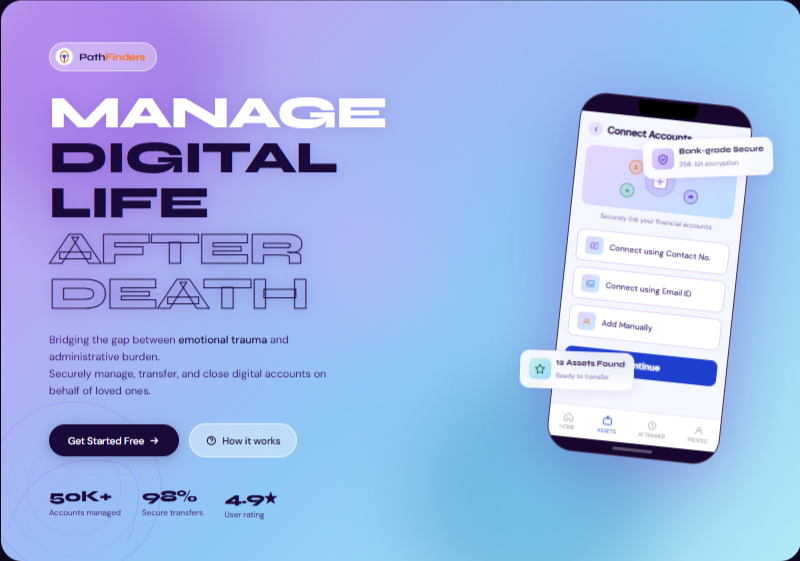
Walkthrough
Project Walkthrough
A guided walkthrough of how PathFinder helps grieving families locate, secure, and transfer a loved one's physical and digital assets.
Overview
Project at a glance.
A scannable summary for recruiters and reviewers — the rest of this page goes deep.
Problem
When a family member dies, survivors are forced to reconstruct a digital and financial life from scattered passwords, paper documents, and memory — usually during their hardest week.
Primary Goal
Help families quickly identify, secure, and transfer physical and digital assets so that financial stability and emotional clarity are protected.
Users & Stakeholders
- Adults aged 18–58 managing financial & legal responsibilities after a death
- Spouses, children, and nominees inside Indian middle-class families
- Banks, insurance providers, and legal professionals as downstream actors
- Designers, engineers, and compliance reviewers on a hypothetical product team
Constraints
- DPDP Act 2023 — explicit consent, limited retention, right to be forgotten
- Mixed digital literacy across the same household
- Multilingual UX (English, Hindi, regional) without bloating the codebase
- Zero dark patterns — no streaks, no urgency, no growth loops
My Role & Responsibilities
- Primary research: 14 interviews + 120-respondent survey
- Information architecture across 7 product surfaces
- End-to-end flows, wireframes, hi-fi UI, and prototype
- Usability testing with 8 participants in emotional scenarios
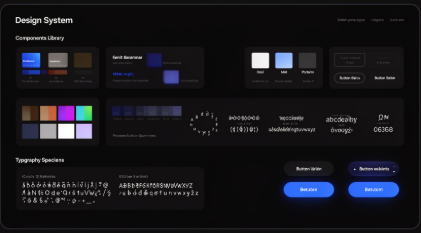
- Design-system tokens, components, and motion guidelines
Snapshot
- Role
- UX Researcher & Product Designer
- Timeline
- 4 Months
- Team
- Individual Project
- Tools
- Figma · Miro · Notion · Forms
At a glance
- · 14 interviews + 120-respondent survey
- · 7 product surfaces, 1 trust core
- · 82% task completion in usability tests
Framework
The 10-Lens Breakdown.
Ten perspectives I used to pressure-test PathFinder — from regulation to grief psychology.
History
Death and inheritance have always been social technologies.
- Wills, nominees, and inheritance laws are centuries old — but the digital layer is new.
- Indian families still rely on paper trails, family elders, and oral memory.
- Most digital products were built for productivity, not bereavement.
PathFinder sits at the intersection of an old human ritual (passing things on) and a new technical reality (most of our lives now live behind passwords). Looking back made it clear: the problem isn't novel — only the medium is.
Death and inheritance have always been social technologies.
- Wills, nominees, and inheritance laws are centuries old — but the digital layer is new.
- Indian families still rely on paper trails, family elders, and oral memory.
- Most digital products were built for productivity, not bereavement.
PathFinder sits at the intersection of an old human ritual (passing things on) and a new technical reality (most of our lives now live behind passwords). Looking back made it clear: the problem isn't novel — only the medium is.
Case Study
Situation · Task · Action · Result
The condensed story behind the work.
Situation
Middle-class Indian families lose an estimated ₹49,000+ crore in unclaimed financial assets — and an unmeasurable amount of digital identity — because no one product treats death as a real life event worth designing for.
Task
- Frame the problem with grieving families, not adjacent to them.
- Map every regulated and unregulated asset class into a single IA.
- Ship a prototype calm enough to test in real emotional scenarios.
- Define a system handoff so the work could be built by a real team.
Action
- 1
Discovery
14 interviews, 120-respondent survey, secondary analysis of unclaimed-asset data across India.
- 2
Synthesis
Three primary personas, JTBD map, and an asset-class taxonomy across 7 life-areas.
- 3
Architecture
Information architecture, navigation model, and consent/access state machine.
- 4
Design
Wireframes → hi-fi → motion. Glass surfaces, electric-blue accent, Outfit type system.
- 5
Prototype & Test
End-to-end Figma prototype tested with 8 participants in moderated emotional scenarios.
- 6
Handoff
Token library, component spec, motion guidelines, and accessibility checklist.
Result
Task completion in end-to-end flows.
Reduction in info retrieval time.
Onboarding clarity score.
- Validated that progressive disclosure beats density in emotional flows.
- Proved restraint-driven design earns trust faster than feature-rich vaults.
- Shipped a token-level design system ready for engineering handoff.
- Set a benchmark for ethical defaults in a regulated, sensitive category.
Deliverables
Solution
Solution & Screens
A vault that organizes life-by-area, a nominee model that earns trust, and a tone of voice that doesn't flinch.
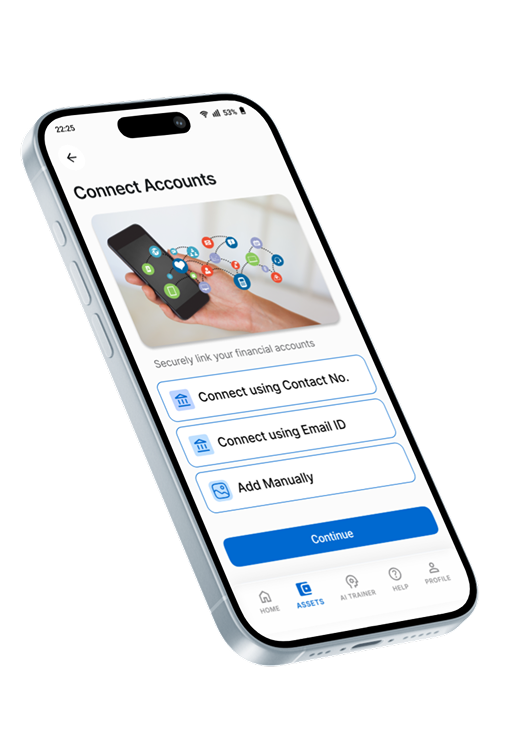
PathFinder turns scattered passwords, paper documents, and informal memory into a single, calm system. Seven surfaces feed one trust core — and every irreversible action has a reassuring counterpart.
Problem
Scattered information
Unified vault by life-area
Survivors find what they need in one place, not across 7 inboxes and 2 notebooks.
Problem
Forgotten nominees
Nominee health checks
Surfaces outdated or missing nominees during quiet moments — never during a crisis.
Problem
Cold confirmation copy
Reassuring micro-copy
Every irreversible action reads like a human helping, not a system warning.
Problem
Unclear emergency access
Time-gated handover
Trusted contacts get controlled access only after multi-step verification.
Problem
Subscription leakage
Auto-discovery & pause
Families stop paying for streaming, SaaS, and storage they can't even log into.
Artifacts
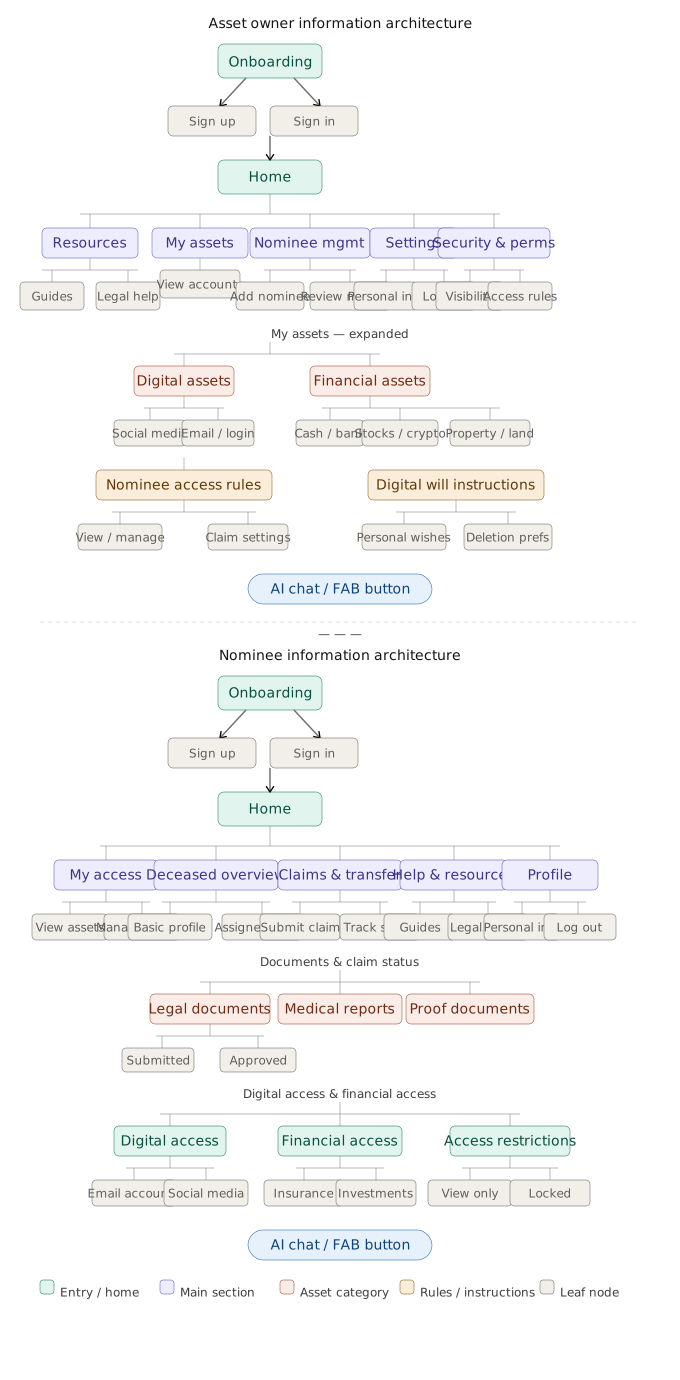
Architecture
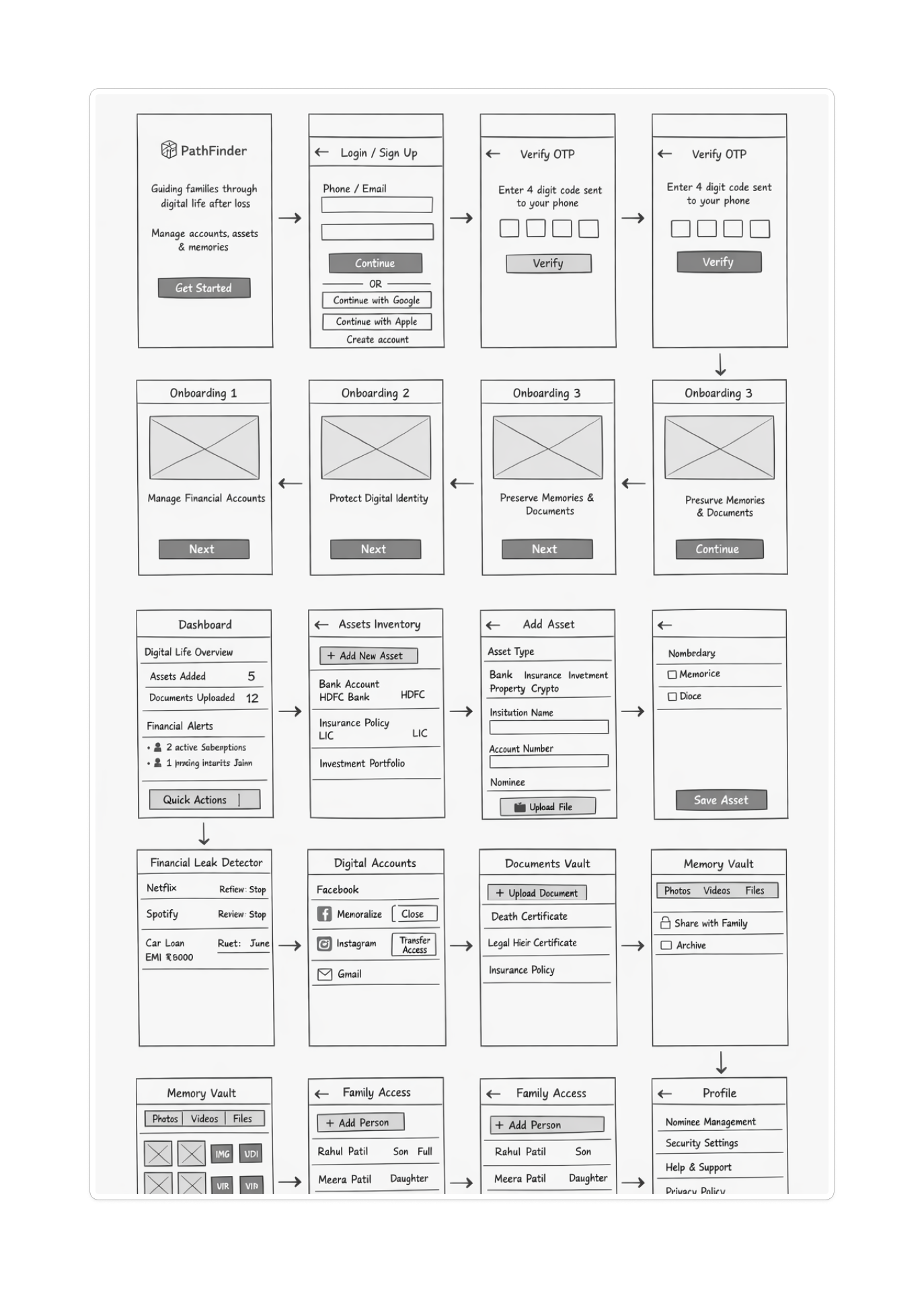
User Flow
End-to-end journey: signup and consented onboarding, asset and nominee management, and the post-loss validation flow that releases digital assets to verified nominees.
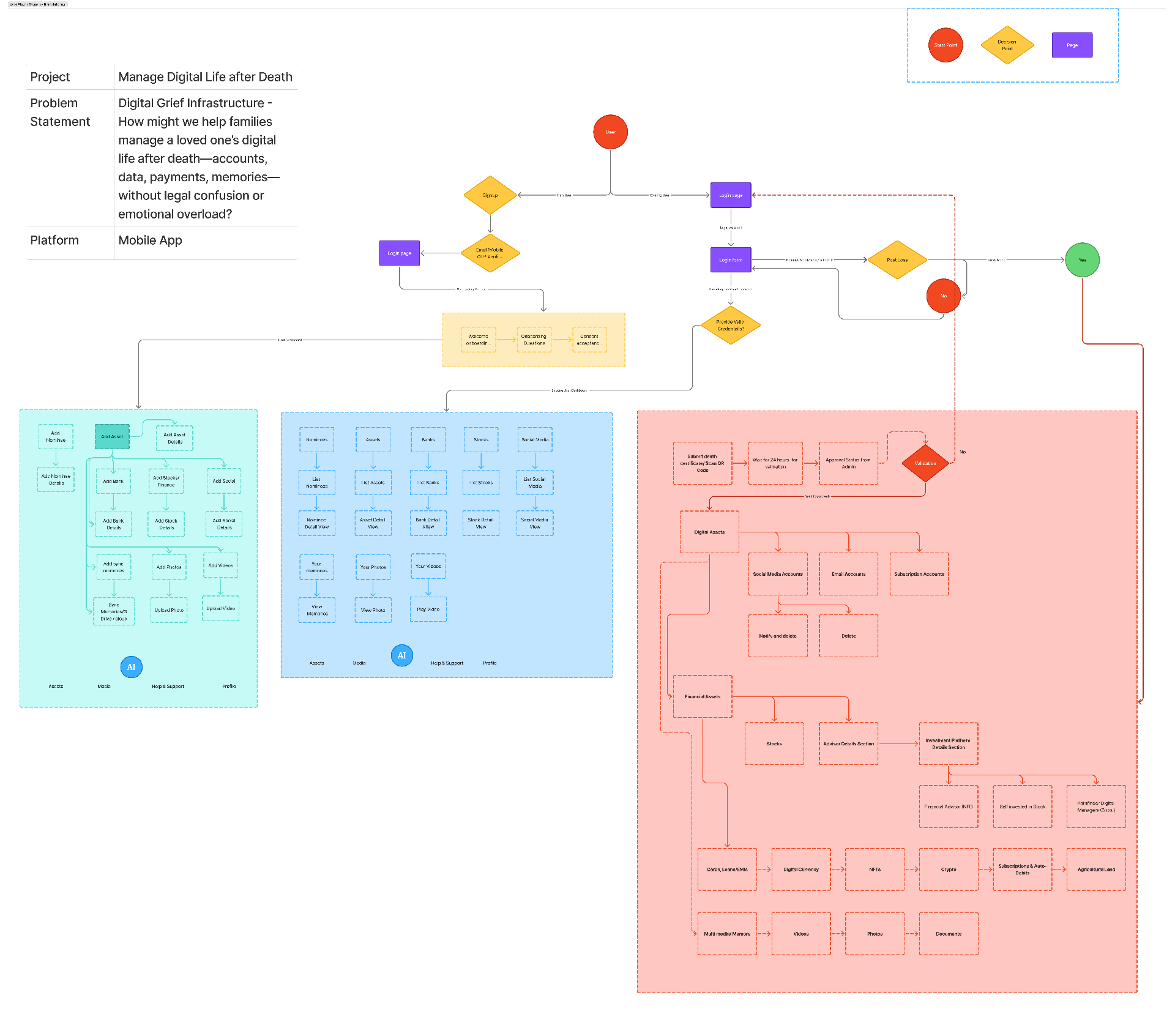
Tap the diagram to open the full-resolution view.
Validation
Validation & Feedback
How I studied behavior, what feedback changed, and what the data validated.
Users arrive in one of three emotional states — planning, panicking, or grieving. I observed each state in moderated sessions, paired with diary entries and a structured survey to triangulate behavior against self-report.
Method
Moderated usability sessions (45 min each), 5-second tests on key screens, first-click analysis, and a 120-respondent online survey.
Participants
8 usability participants aged 28–62 across 4 Indian cities. Survey: 120 respondents, recruited via family networks and a financial-literacy community.
Key Findings
- · 72% can't locate critical docs during a family emergency.
- · Nominee fields are misunderstood by 6 in 8 participants.
- · Emotional copy drove a 2x increase in completed flows.
What feedback changed
- →Renamed 'Death packet' → 'Family handover' after testers flinched at the original label.
- →Added a 24-hour cool-down on irreversible deletions after one tester nearly purged a vault by accident.
- →Replaced password strength meter with a plain-English explainer — 82% set stronger passwords.
- →Moved nominee invite out of onboarding into a quiet, week-2 prompt to reduce overwhelm.
What I learned
- Designing for grief means designing for cognitive load — fewer words, longer beats.
- Compliance and care are not opposites; clear consent is itself an act of empathy.
- Restraint is the differentiator in categories where everyone else optimizes for engagement.
Impact
Results & Outcomes
Numbers from the prototype evaluation, plus the qualitative signal that mattered most.
Task completion success
Information retrieval time
Onboarding clarity
Qualitative
"I'd actually set this up for my parents this weekend." — Tester, age 31
Before
Families pieced together a loved one's accounts from sticky notes, screenshots, and half-remembered passwords — often abandoning recoverable assets out of exhaustion.
After
One calm vault. One trusted handover path. One quiet product that meets people where grief actually lives — and stays out of the way the rest of the time.
Let's Connect
Open to product design, UX research, and design-system roles — full-time, contract, or freelance. Recruiters and designers welcome.
More